
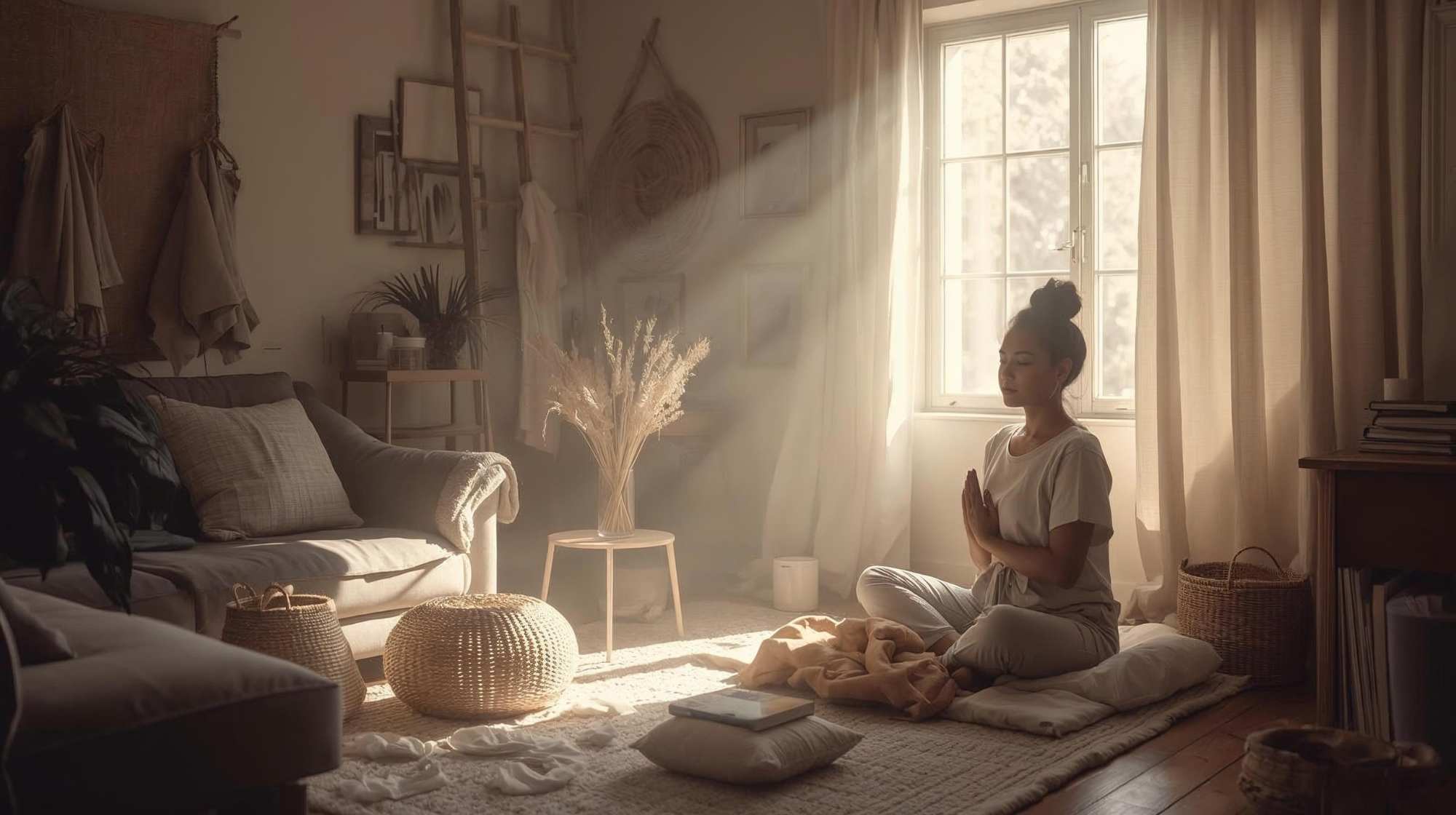
The “Choose Calm” Mindset: A Gentle Daily Practice (Not a Personality Change)
There’s a lot of talk online about being calm.
Calm morning routines. Calm energy. Calm people. Calm lives.
And if you’re anything like most humans, you’ve probably thought at some point: That sounds nice… but that’s not really me.
Maybe you’ve tried the breathing exercises. Maybe you’ve downloaded the meditation app. Maybe you’ve even rearranged your mornings to be slower, quieter, more intentional—only to find yourself right back where you started, wondering why everyone else seems to have figured this out except you.
Here’s the truth that rarely gets said out loud: calm isn’t a personality trait. It’s not something you either are or aren’t. And it’s definitely not something you have to force yourself into.
The choose calm mindset isn’t about changing who you are. It’s about how you meet your day—gently, imperfectly, and on purpose.
Calm Isn’t Something You Become — It’s Something You Choose
When people talk about calm, it often sounds like a permanent state. Like once you “figure it out,” stress disappears and you float peacefully through life, unbothered by traffic, deadlines, or the everyday chaos that just is.
That’s not real life.
Real life is messy. It’s interruptions and last-minute changes and things not going according to plan. It’s forgetting your own good intentions by 9 a.m. and realizing you’ve been holding your breath without noticing.
Choosing calm doesn’t mean:
- You never get irritated
- You stop caring deeply about things that matter
- You suddenly love silence or slow mornings
- You fix your thoughts or become someone who “doesn’t worry”
- You achieve some perfect inner peace that never wavers
Choosing calm means you create a little space between what happens and how you respond. Sometimes that space is a breath. Sometimes it’s a pause before you speak. Sometimes it’s simply deciding not to add extra pressure to a moment that’s already hard enough.
And some days, you forget entirely. You react. You rush. You spiral. That still counts as part of the practice—because noticing you forgot is the practice.
If you like a simple starting point, you might also enjoy this beginner-friendly guide to spiritual meditation and how to do it.
Why the Choose Calm Mindset Works in Real Life
The reason the choose calm mindset resonates with so many people is simple: it works with reality, not against it.
You don’t need:
- A perfect schedule that never gets disrupted
- A meditation streak you’re afraid to break
- A quiet house with no noise or demands
- A new identity or complete personality overhaul
- Hours of free time you don’t actually have
Instead, calm becomes something you return to, not something you maintain. It’s not a state you achieve once and then protect fiercely. It’s a choice you make—over and over, in small moments throughout your day.
This approach:
- Reduces decision fatigue by simplifying what calm actually requires
- Removes the “I’m doing it wrong” feeling that makes everything harder
- Makes calm accessible on busy, messy, imperfect days
- Supports a gentle mindfulness mindset instead of rigid routines that feel like one more thing to fail at
- Allows you to be exactly who you are while still finding peace
You’re not chasing calm like it’s something outside yourself. You’re inviting it in, remembering it’s already available to you right now—even if this moment feels anything but calm.
Choosing Calm Without Changing Who You Are
One of the biggest misconceptions about calm is that it requires becoming someone else. Someone softer. Someone who doesn’t feel things so intensely. Someone who naturally enjoys quiet and stillness and doesn’t mind when plans fall apart.
But calm doesn’t ask you to be quieter, softer, or less emotional. It doesn’t require you to shrink or smooth out your edges or apologize for caring too much.
Calm adapts to you.
If you’re expressive and passionate, calm might look like grounding yourself before speaking so your words land the way you mean them to. If you’re anxious by nature, calm might be offering yourself reassurance instead of harsh self-criticism. If you’re naturally energetic, calm might be channeling that energy through intentional movement instead of scattered rushing.
If you’re someone who experiences vivid inner imagery during meditation, you’ll love this: seeing colors when you meditate (and what they may mean).
Calm isn’t about erasing your personality. It’s about supporting it. It’s about becoming more yourself, not less—just with a little more space to breathe.
Small Calm Identity Habits That Add Up
You don’t need a full routine to embody calm. You don’t need an hour-long morning ritual or a complete life restructure. You need a few calm identity habits that feel realistic for the life you’re actually living.
Here are some gentle ones that work quietly in the background:
- Pausing before responding, even just once a day when it matters
- Letting one moment be unfinished—the conversation, the task, the thought
- Choosing “good enough” instead of perfect, especially when no one will notice the difference
- Creating one small calming anchor you can return to (a deep breath, a grounding phrase, a texture or object)
- Reducing friction instead of adding more tasks to your already-full day
- Noticing when you’re holding tension in your body and softening just slightly
- Saying no to one thing that doesn’t truly need you
These habits don’t announce themselves. They don’t feel dramatic or transformative in the moment. They slowly shift how your days feel—like adjusting the temperature one degree at a time until suddenly, you realize you’re more comfortable.
If you enjoy the idea of gentle consistency, you might like exploring what “sadhana” means (and why it’s more about devotion than perfection).
Choosing Calm Daily in Ordinary Moments
Most calm advice focuses on ideal conditions. Early mornings. Quiet spaces. Uninterrupted time.
Real calm shows up in ordinary ones. In the middle of mess and noise and inconvenience.
You can practice choosing calm daily:
- While waiting in line at the grocery store, resisting the urge to mentally rush the person ahead of you
- When the noise gets overwhelming and you can’t escape it—but you can soften your resistance to it
- When plans change and you have to pivot, deciding whether to fight the change or flow with it
- When your thoughts spiral into worst-case scenarios, and you gently redirect without judgment
- When you feel rushed for no real reason except habit
Sometimes choosing calm is doing less. Canceling the unnecessary. Letting something slide that doesn’t actually matter.
Sometimes it’s letting a thought pass without arguing with it, without making it mean something about you.
Sometimes it’s simply saying, “I don’t need to fix this right now.” And meaning it.
Need a quick reset you can actually finish? Try this guided 10-minute chakra meditation for balance and harmony.
The Choose Calm Mindset and Slow Living Philosophy
Slow living often gets misunderstood as a lifestyle you have to adopt fully—complete with matching aesthetics, a capsule wardrobe, and a commitment to making everything from scratch.
But slow living philosophy is less about pace and more about presence. It’s not about how fast or slow you move through your day. It’s about how you’re moving—on purpose or on autopilot.
You don’t need:
- A minimalist home that looks like a magazine spread
- A rural escape far from the demands of modern life
- Long, uninterrupted mornings with nothing on the calendar
- Permission from anyone to slow down
You can live fast and still choose calm. You can have a full schedule and still move through it with intention. The two aren’t opposites.
Slow living, in this sense, means:
- Being intentional with your energy instead of giving it away by default
- Allowing moments to be what they are without immediately trying to change them
- Letting life move without constantly pushing back against its natural rhythm
- Recognizing when you’re adding urgency that doesn’t exist
It’s not about slowing everything down—it’s about softening how you move through it.
If you like “calm through creativity,” you’ll enjoy mindful creativity and unlocking your inner artist through presence.
Intentional Calm Living vs. Forcing Relaxation
There’s a difference between inviting calm and forcing relaxation. And you can probably feel the difference in your body when you read those two phrases.
Forcing calm often sounds like:
- “I should be more relaxed”
- “Why can’t I just calm down already?”
- “Everyone else can do this, what’s wrong with me?”
- “I’m failing at being calm, which is making me stressed about being stressed”
Intentional calm living sounds quieter, gentler:
- “What would feel a little softer right now?”
- “What can I let go of in this moment, even temporarily?”
- “It’s okay to meet today exactly as it is”
- “I don’t have to fix everything today”
Notice the shift? One adds pressure. The other releases it.
Calm grows where pressure isn’t. It needs space, not force. It responds to invitation, not demands.
A Simple, Flexible “Choose Calm” Practice
If you want something tangible—without turning it into a rule you’ll eventually rebel against—try this:
Once a day, ask yourself:
“What would choosing calm look like right now?”
That’s it. No right answer. No specific outcome required.
Some days it’s taking one full breath before responding to an email that irritated you.
Some days it’s stepping away from your screen for two minutes.
Some days it’s deciding not to have the argument you were building in your head.
Some days it’s doing nothing differently at all—just noticing that you have the choice.
The practice isn’t the action you take. The practice is the question itself. The pause. The remembering that you have agency, even when it doesn’t feel like it.
If movement helps you find calm faster than sitting still, you might like exploring grounding poses like Virasana (Hero Pose) or building strength-with-breath through Chaturanga Dandasana.
When You Forget to Choose Calm (Because You Will)
There will be days when calm feels very far away. When you snap at someone you love. When you spiral into worry. When you rush through your entire day and only realize at bedtime that you never once slowed down.
That doesn’t mean you failed. It means you’re human.
Calm isn’t something you hold onto forever, white-knuckling it so it doesn’t slip away. It’s something you return to—again and again, without judgment, without making it mean anything about who you are.
Every moment is another chance to choose it softly. Not desperately. Not as proof that you’re getting better or doing it right. Just… choosing it because you can.
And on days when you need a quick emotional “reset,” a small smile can be a doorway. This one’s lighthearted but surprisingly grounding: 10 hilarious reasons to smile every day.
Calm Is a Direction, Not a Destination
The choose calm mindset isn’t about arriving somewhere new. It’s not a finish line you cross or a problem you solve once and for all.
It’s about gently changing direction when you notice you’ve been pushing too hard. When you’ve been holding your breath. When you’ve been adding pressure that doesn’t need to be there.
You don’t need to be calmer. You don’t need to become someone else. You don’t need to get it right.
You just need one moment of choice. One small redirect toward gentleness instead of force.
And then another, when you’re ready.
That’s the whole practice.