
1. Evenings Don’t Have to Be Abrupt
There is a particular kind of exhaustion that has become familiar to many of us. You sit down at the end of a long day, screen-lit and overstimulated, and at some point realize you should probably go to sleep. So you close the laptop. Turn off the lights. Lie down. And then — nothing. Your body is in bed, but your mind is still running. You are, as the phrase goes, tired but wired.
This is not a personal failing. It is the predictable result of how most modern evenings unfold: bright overhead lights, the constant flicker of notifications, background noise from shows or podcasts, a low hum of unfinished thoughts. We go from full stimulation to expected sleep with almost no transition at all. We treat the end of the day like flipping a switch, and then wonder why sleep doesn’t come easily.
But the body does not work like a switch. It works more like a dimmer. It needs time, and signal, and permission to slow down. If you’ve ever experimented with something like a 2-minute reset routine during the day, you already understand how powerful small transitions can be. Evenings deserve the same attention.
The idea at the heart of this piece is simple: instead of ending the day abruptly, you dim it. You give yourself a soft landing — a short window of intentional quiet and warmth before you close your eyes. Not a productivity routine. Not a self-optimization protocol. Just a gentle transition, on purpose.
2. Why Light and Sound Matter More Than We Think
Light as a Nervous System Signal
Your body is exquisitely sensitive to light. Bright, cool light — like overhead fluorescents or the glow of a phone screen — signals alertness to your nervous system. It is the biological equivalent of morning, regardless of what the clock says.
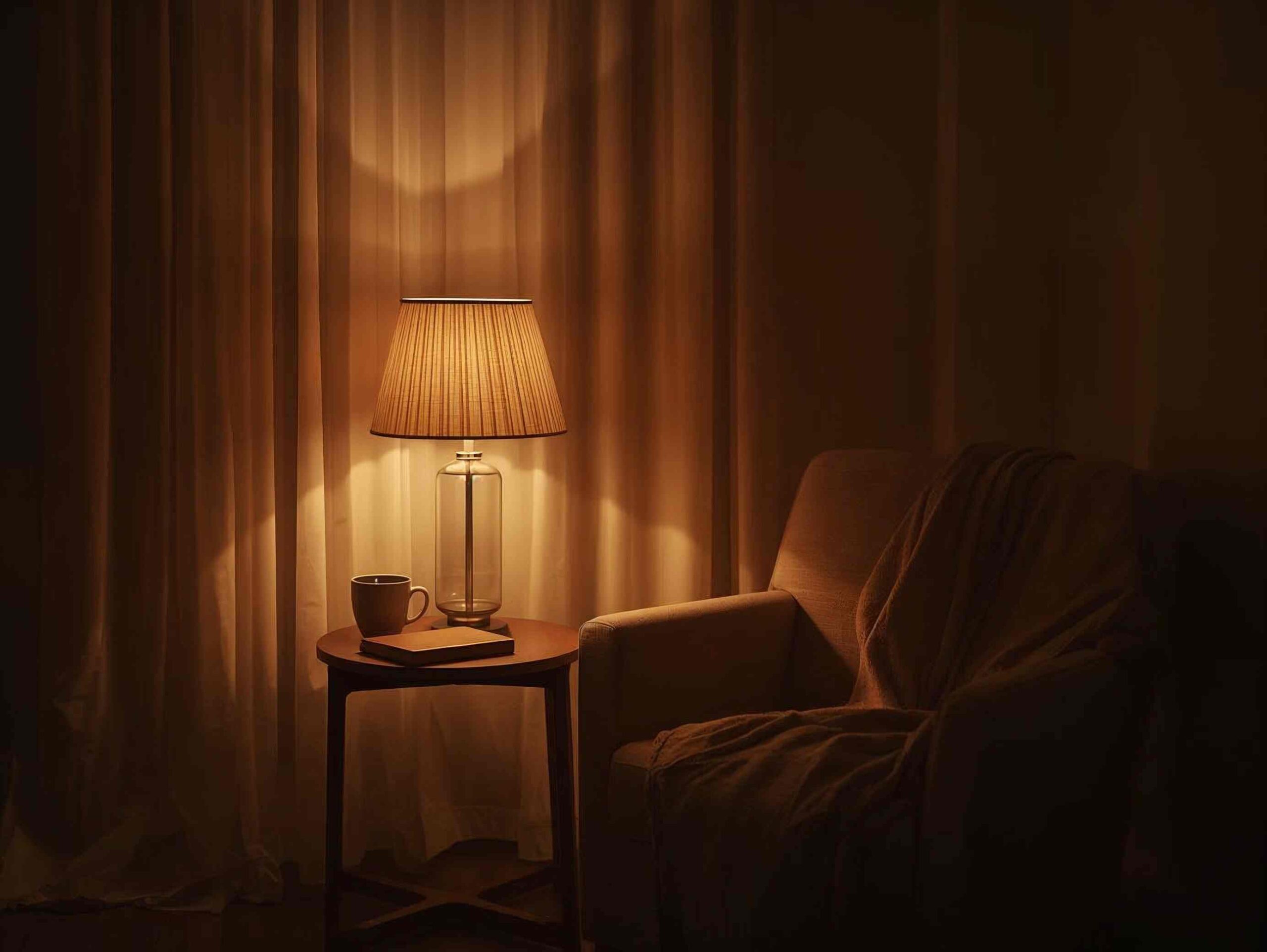
Warm, dim light tells a different story. It mimics the amber tones of dusk — the light that, for most of human history, told the body that the day was ending and it was safe to rest. Switching from overhead lighting to lamps, candles, or a warm-toned salt lamp in the evening is not just aesthetic. It is a quiet signal that the long, alert day is drawing to a close.
If you’re curious about how meditation and relaxation practices support this kind of transition, the Mayo Clinic overview on meditation offers a helpful, grounded explanation of how simple calming practices influence the body.
You do not have to eliminate screens entirely. But reducing brightness, enabling night mode, and stepping away from them for even fifteen minutes can make a genuine difference in how quickly you unwind.
Sound as an Emotional Regulator
Silence is underrated — and at the same time, it is not always restful. Many people find that quiet at night amplifies anxiety. With no sound to fill the space, the mind fills it instead.
Gentle sound works differently. Soft rain, low ambient tones, or slow instrumental music creates a soft landing — an auditory texture that gives the mind something neutral to settle into. If you enjoy guided or ambient support, you might also appreciate this guide on what a calm daily meditation can look like in everyday life.
3. What Is the “Dim the Day” Routine?
At its simplest, the Dim the Day routine is this:
A 20–30 minute intentional dimming of light and stimulation before bed, using layered soft lighting and gentle background sound to ease the transition from the day into sleep.
There is no required equipment and no rigid sequence. The point is not to follow a system. The point is to give your body a cue — repeated gently, night after night — that rest is available.
If you are building a more peaceful environment overall, you may also enjoy creating a mindful home that supports calm not just at night, but throughout the day.
4. Step-by-Step: The Dim the Day Routine
Step 1: Turn Off the Overhead Lights
This is the most important step. Switch to something warmer and lower — a floor lamp, a table lamp, or a candle. The atmosphere shifts almost immediately. The harshness lifts. The space feels calmer and more contained.
Step 2: Lower the Volume of the World
Before you add anything soft, remove what is sharp. Turn down the television. Silence notifications. Let background noise fade.
Step 3: Add One Gentle Sound Layer
Choose a single, undemanding audio source and let it play softly in the background. Rain sounds, ambient instrumental music, or slow piano all work well. If you’d like a simple place to start, you can explore long-form ambient sessions on my meditation channel here:
Keep it continuous and neutral — not a playlist that shifts moods, and not a podcast that requires attention.
Step 4: Do One Slow, Simple Activity
Wash your face slowly. Make herbal tea. Write one page in a journal. Light stretching. Folding laundry. These activities are not techniques. They are gentle occupation for your hands while your nervous system settles.
If journaling feels supportive, you might find inspiration in this reflection on slowing down with simple rituals in everyday life.
Step 5: Sit in the Dimness for 3 Minutes
Before getting into bed, sit. No goal. No required breathing technique. Simply let your body register that the movement of the day has stopped. Think of it as the last note of the day, held just a little longer.
5. For People Who Feel Restless at Night
If silence makes you anxious, you are not doing anything wrong. The gentle sound layer exists precisely to give the mind something benign to rest against.
If your brain replays the day after 9 PM, try writing a short account of what happened and what you are letting go of. Getting it onto paper can make it easier to release.
6. A Small-Space Version
One lamp. One audio source. One chair or corner of a sofa. That is a complete setup. The routine works in studio apartments, shared homes, or behind a closed bedroom door. Atmosphere is not about aesthetics. It is about attention.
7. A 10-Minute Version for Busy Days
- Turn off the overhead light and switch to a single lamp.
- Play one calming track on low volume.
- Wash your face and brush your teeth slowly.
- Sit on the edge of the bed for sixty seconds before lying down.
It is not glamorous. But it shifts the quality of how you enter sleep — less abrupt, more like an arrival than a collapse.
8. Why This Works
Your body responds to cues. Ritual signals safety. Repetition builds association. Over time, dimming the light or pressing play on rain sounds becomes a signal your body recognizes.
Soft cues are more powerful than strict rules because they invite rather than insist. Sleep is not something you force. It is something the body eases into when conditions are supportive.
9. Optional Add-Ons
- Herbal tea such as chamomile or lemon balm.
- A warm shower in low light.
- Light fiction reading.
- A diffuser with lavender or cedarwood.
- A blanket and a low floor lamp for added warmth.
These are invitations, not instructions.
10. You Don’t Have to Collapse Into Sleep
Most of us have been taught that sleep happens when there is nothing left to do. But there is another way to meet the night — not as a shutdown, but as a gradual softening.
The Dim the Day routine is not a hack. It is a small, repeatable kindness. A way of acknowledging that the transition to sleep is worth attending to — and that you are worth attending to.
You don’t have to crash into the night.
You can dim the day instead.
Slowly. Gently. On purpose.
Start tonight with one lamp and one quiet sound. That is enough.