

Prayer Journaling for Beginners: A Simple Way to Pray, Reflect, and Practice Gratitude
When You Want to Pray but Don’t Know What to Say
You sit down meaning to pray, and within about four seconds your mind gets crowded.
What should I even say? Am I doing this right? Should I be asking for something, or just saying thank you? Why does my brain suddenly feel like it’s hosting a meeting with no agenda?
If that sounds familiar, you’re not bad at praying. You’re just trying to hold a whole conversation in your head, and heads are a genuinely terrible place to hold a conversation. Thoughts slip. They loop. They wander off toward the grocery list before you’ve finished the first sentence.
This is where prayer journaling comes in. It gives those scattered thoughts somewhere to land. Instead of trying to compose the perfect prayer silently, in real time, under pressure, you just start writing.
Messy is fine. Short is fine. A single honest sentence is fine.
Your prayer journal doesn’t have to be impressive. It only has to be honest.
That’s really the whole idea behind this piece: what prayer journaling actually is, why people find it helpful, a simple way to start, some prompts for the days your mind goes blank, and what to do when the habit slips, because it will, and that’s fine too.
What Is Prayer Journaling, Really?
Prayer journaling is simply writing down your prayers, your gratitude, your questions, your reflections, and whatever is moving through you spiritually on a given day.
That’s it.
There’s no required format, no correct structure, and no minimum word count.
A prayer journal might contain a written prayer, a list of things you’re grateful for, a worry about someone you love, a line from something you read, a question you don’t have an answer to, a joy you want to remember, a difficulty you’re sitting with, or a quiet note that something you’d been hoping for finally happened.
Some people write pages. Others write three sentences and close the notebook. Someone might write only:
Thank you for getting me through today.
And stop there.
That still counts. There’s no version of this practice that’s too small to be real.
If the idea of creating a quiet spiritual pause is new to you, you might also enjoy exploring what spiritual meditation is and how reflective practices can create intentional space.
It’s Not About Writing the Perfect Prayer
This is worth saying plainly, because it trips up a lot of people before they even begin: your journal is not being graded.
Nobody is checking your grammar. Nobody is scoring your sincerity based on vocabulary.
People get surprisingly self-conscious the moment prayer touches paper. Suddenly they’re worried about spelling, about repeating themselves, about whether what they wrote sounds spiritual enough.
It’s an understandable instinct, and it’s also completely unnecessary here.
There’s an old teaching that prayer isn’t made meaningful by piling up more words. It’s not about eloquence. It’s about actually meaning what you say, however plainly you say it.
So you can cross something out. You can write something awkward, half-formed, mid-thought.
You can literally write:
I honestly don’t know what I’m trying to say right now.
Sometimes that sentence, exactly as it is, is the whole prayer. Nothing more polished needs to happen after it.
https://www.youtube.com/playlist?list=PLI2jGcDEyFdhTJ1CynvX7r8_FKtcDUnzy
Why Writing Changes the Way Prayer Feels
There’s a real, practical difference between thinking something and writing it down.
Thoughts move fast. They overlap, interrupt each other, circle back without warning. Writing forces a slower pace, whether you want it to or not.
When you put a prayer into words on a page, you often notice things you hadn’t quite registered yet.
What you’re actually worried about, underneath the surface version. What keeps showing up, day after day, uninvited. What you’re genuinely grateful for, once you stop to name it instead of just feeling it in passing. Where you’re gripping something a little too tightly and could probably loosen your hold.
This fits naturally with something we talk about a lot around here: the value of a deliberate pause.
Prayer journaling can work as a small transition, a way of moving from mental noise into something quieter and more attentive. The same principle is behind practices like simple grounding exercises, where the goal isn’t to make every thought disappear but to become more present with where you are.
The journal itself isn’t what creates the connection. It just makes room for you to notice it a little more clearly.
Why People Keep Coming Back to Prayer Journaling
It Quiets a Busy Mind
You sit down to pray and your brain immediately produces tomorrow’s meeting, an unpaid bill, something someone said three days ago that you’re still turning over, and a reminder that you’re out of coffee.
This is not a sign you’re bad at this. It’s just what minds do when nothing else is competing for their attention.
Writing gives all of that somewhere to go.
The worry becomes a sentence. The sentence becomes something you’ve said out loud, in a sense, rather than something looping silently. And once it’s on the page, you can set it down, at least for now.
If transitioning from a busy day into a quieter state is difficult for you, the idea behind the Choose Calm mindset is a helpful companion to journaling: calm doesn’t need to be your permanent personality. It can be something you practice one moment at a time.
It Becomes a Record of Where You’ve Been
Most ordinary days disappear from memory almost immediately.
A journal is one of the few things that holds onto them.
Months later, you might flip back and find something you’d completely forgotten you were carrying. Or you might notice that you write about the same situation very differently now than you did back then, even if the situation itself never really changed.
Sometimes the shift isn’t in your circumstances. It’s in you.
I stopped being afraid of that.
I finally let that one go.
I wanted one thing, and got something else, and it turned out to be right.
These are the kinds of small discoveries a journal quietly collects, without you ever setting out to look for them.
It Makes Room for Gratitude, Not Just Requests
Prayer has a tendency to lean heavily on asking.
Help me. Fix this. Show me. Give me.
There’s nothing wrong with that; asking for help is a pretty reasonable thing to do. But journaling naturally opens up space for the other half of the conversation too.
Thank you.
It’s worth noticing the small, ordinary stuff here: a quiet morning, a good meal, getting home safely, someone’s unexpected kindness, a moment that made you laugh, a sky that looked like it was trying to show off.
Gratitude in a journal doesn’t require pretending everything is fine. You can write about something difficult and something you’re thankful for on the very same page.
Both things can be true at once.
How to Start Prayer Journaling for Beginners
What You Need
Something to write on.
Something to write with.
That’s genuinely the whole list.
A plain notebook works. A beautiful one works too, if that’s your thing. So does the notes app on your phone, a Google Doc, or a dedicated journaling app if you like that kind of structure.
You don’t need a leather-bound journal, matching pens, candles, or a perfectly styled prayer corner that looks good in a photo.
Those things are nice if you enjoy them. They’re never required.
The practice matters more than the props.
When to Do It
Skip the productivity-culture instinct to declare that everyone must journal at five in the morning before the sun’s even considered rising.
Journal whenever it actually fits your life.
That might be right after waking up, with your coffee still too hot to drink. A quiet first drink can become its own little transition into reflection, much like the First Sip Ritual.
It might be during lunch, right before bed, on a slow Sunday afternoon, or simply whenever something is sitting heavy enough on your chest that you need somewhere to put it.
The best time to journal is the time you’ll actually return to.
Consistency helps, but it shouldn’t turn into one more thing generating guilt when you miss a day.
Which you will.
Everyone does.
A Simple Five-Step Prayer Journaling Method for Beginners
If you’d like something to lean on rather than staring at a blank page hoping inspiration arrives, here’s a simple structure.
You don’t have to follow it exactly, and you can skip steps entirely some days. Think of it as a starting shape, not a rulebook.
Step One: Pause
Before you write anything, just stop for a second.
Put the phone somewhere else. Take one comfortable breath. Let whatever you were just doing settle a little before you begin.
You could open with something as simple as:
I’m here.
That’s enough of a beginning.
Creating spaces for small pauses throughout daily life can make this easier over time. Even something as simple as a five-minute pause before going inside can help create a clearer boundary between one part of the day and the next.
Step Two: Thank
Write down one to three things you’re grateful for.
Try to be specific rather than sweeping.
Instead of:
Thank you for everything.
Try:
Thank you for the conversation I had with my friend today.
Or:
Thank you for giving me enough patience to get through that meeting.
The small, specific stuff tends to land more than the broad, general stuff.
Step Three: Tell
Now say what’s actually going on.
Not the tidy, presentable version. The real one.
What’s on your mind? What hurt today? What made you smile without meaning to? What are you afraid of? What don’t you understand?
Write the way you’d actually talk, not the way you imagine a prayer is supposed to sound.
Step Four: Ask
Write down what you need.
Maybe it’s wisdom, patience, courage, forgiveness, direction, or just a little more strength than you currently have.
It’s worth asking not only for your circumstances to change but for how you might need to change too.
Instead of only:
Please fix this.
You might also write:
Help me see how I should respond to this.
That’s a small shift, but it tends to open something up.
Step Five: Release
Close by setting the concern down, at least for now.
Something like:
I’ve told you what I want and what I’m afraid of. Help me trust what happens next.
Releasing doesn’t mean the worry vanishes on the spot. You’ll probably think about it again tomorrow, and that’s fine.
Releasing just means acknowledging that you don’t have to hold every part of it by yourself.
Prayer Journaling Prompts for the Days Your Mind Goes Blank
Some days the words come easily.
Other days you sit there and nothing arrives.
These prayer journaling prompts are for those days.
Gratitude Prompts
- What am I thankful for today?
- Where did I notice unexpected kindness?
- What ordinary thing have I been overlooking?
- Who am I glad is in my life?
- What made me smile today, even briefly?
Reflection Prompts
- What’s been occupying my thoughts lately?
- What am I having a hard time letting go of?
- Where could I use more patience?
- What did today actually teach me?
- Where might I have responded more gently?
Prayer Prompts
- Who needs a little extra thought from me today?
- What am I trying too hard to control?
- Where do I need clarity?
- What am I hesitant to even bring up?
- What do I need strength for right now?
Growth Prompts
- What’s something I read or heard recently that stuck with me?
- What might it be pointing me toward?
- Where have I noticed myself changing lately?
- What’s one small thing I could do tomorrow that moves in a good direction?
Pick one.
Write for two minutes.
See what shows up.
When Prayer Journaling Feels Difficult
“I Don’t Know What to Write.”
Write exactly that sentence.
I don’t know what to write today.
Then keep going:
But here’s what’s actually on my mind.
Usually something follows.
And if nothing does, that’s fine too. The page doesn’t need to be full for the practice to count.
“I Missed a Bunch of Days.”
No guilt.
No catching up.
No backdating a week’s worth of entries like forgotten homework.
Just turn to the next blank page, write today’s date, and start again.
A spiritual practice shouldn’t turn into a streak you’re afraid of breaking.
“Nothing Seems to Be Changing.”
This one deserves a gentler answer than a tidy formula.
Sometimes what you were hoping for happens. Sometimes it doesn’t, or not in the shape you expected. Sometimes you’re still waiting, and you genuinely don’t know why.
A journal can help you notice that the shift isn’t always in your circumstances.
Sometimes it’s in how you’re carrying them.
There’s an old moment often referenced in reflective writing, of someone saying plainly what they wanted while still being willing to accept a different outcome.
That’s not a bad model for honest prayer:
Say what you want, say what scares you, and leave a little room for something other than exactly what you asked for.
Reading Something Short Before You Journal
If you like combining prayer journaling with a bit of reading, here’s a simple four-part structure:
Read. Notice. Reflect. Pray.
Choose a short passage, a few lines, nothing long.
Notice one phrase or idea that catches your attention.
Reflect for a moment on why it caught you specifically, today.
Then turn that reflection into a short prayer of your own.
As an example, consider the familiar opening of Psalm 23: “The Lord is my shepherd.”
You might notice it, then ask yourself where you’ve been trying to navigate everything entirely on your own.
And the prayer that follows might be as simple as:
Help me remember I don’t have to know every step before I take the next one.
You don’t need a whole study guide for this.
A few quiet minutes with one short passage is plenty.
Your Prayer Journal Doesn’t Have to Look Like Anyone Else’s
Somewhere out there is a beautifully kept prayer journal with color-coded tabs, careful calligraphy, and highlighting that looks intentional rather than chaotic.
Yours does not have to look anything like that.
Yours can have coffee rings.
Crossed-out sentences.
Handwriting that gets worse toward the bottom of the page as your hand gets tired.
None of that makes it less real.
You can fill it with drawings, short lists, a line from something meaningful, a snippet of a song that means something to you, a letter you never intend to send, a question with no answer yet, or just a lot of empty space.
The point was never the presentation.
It was making room to notice something.
If you’d like to make your surroundings support that quiet time as well, these ideas for creating a calmer, more mindful home can help you carve out a simple place for reflection without needing an elaborate prayer space.
A Seven-Day Prayer Journaling Experiment
If you’d rather try this than think about it, here’s a light structure for one week.
No pressure to keep it going afterward.
Just see what a week actually feels like.
- Day One: Write three things you’re grateful for.
- Day Two: Write about one thing you’ve been carrying.
- Day Three: Write a short prayer for someone else.
- Day Four: Read one short passage and reflect on it.
- Day Five: Write about something you need to forgive, or be forgiven for.
- Day Six: Ask for a little guidance on something specific in your life.
- Day Seven: Go back and read the previous six entries, and just notice what’s changed, or hasn’t.
No promises about transformation in seven days.
Just an invitation to pay a little more attention than usual.
And if solitude feels especially natural to you, you may appreciate these thoughts on cultivating inner peace when you’re naturally drawn to quieter spaces.
Sometimes Prayer Journaling Begins With a Blank Page
A blank page.
A pen.
Someone who isn’t quite sure what to say.
That’s a fine place to start.
Maybe it begins with “thank you.”
Maybe with “help.”
Maybe with “I’m confused” or “I don’t understand what’s happening right now.”
Every one of those is a valid opening line.
The goal was never to fill the most pages or keep the longest streak.
It’s making a little room, regularly, for honesty, gratitude, reflection, and attention.
That’s really all a prayer journal is asking of you.
You don’t need the perfect notebook, the perfect time of day, or the perfect words.
Just open to a blank page, bring whatever’s actually sitting in your chest, and start there.
Often the simplest prayer turns out to be the most honest one.
If you’d like to sit with that a little longer, pair a few quiet minutes of journaling with something soft in the background. A little stillness tends to make the words come easier. You can explore calm practices that don’t require sitting perfectly still, or simply put on something peaceful and let yourself slow down.
And whenever you’d like a quiet soundtrack for prayer, journaling, reflection, relaxation, or simply a few minutes away from the noise, you’re always welcome to join Relax with Z on YouTube.
Bring the notebook.
Bring the coffee if you want.
Bring whatever kind of day you’ve had.
And begin exactly where you are.
A Personal Note: August, My Father, and the Things We Carry Forward
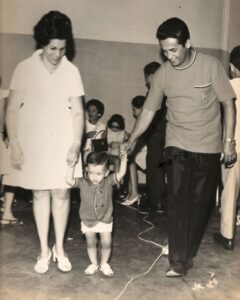 Before I close, this article happens to arrive during a month that carries a little more meaning for me than most.
August is the month of Father’s Day in Brazil, and it gives me another reason to remember and honor my father. His birthday was August 6, which just passed, giving me one more reason to pause and remember him during this already meaningful month.
He was the founder of the 1st Jungle Communications Battalion in Brazil and served as its first and later its third commander. The battalion celebrated its 50th anniversary in 2019, marking the years 1969–2019. (1969 was also the year I was born, so apparently 1968 was a very busy year for my father — professionally and personally. 😂)
That same year, my father passed away.
And that same year, I had my stroke.
As I’ve shared elsewhere on this journey, I don’t look at coincidences quite the way I used to. There is an old saying I have always loved:
“Coincidence is God’s way of remaining anonymous.”
I don’t pretend to understand why certain dates, people, losses, beginnings, and endings sometimes seem to gather around one another. Maybe not everything needs an explanation. Sometimes it is enough simply to notice.
August carries another important Brazilian remembrance as well. August 25 is Dia do Soldado — Brazil’s Day of the Soldier. For me, that makes this month especially connected to my father’s life of military service.
Brazilian culture also carries a remarkable mixture of traditions. Within the Afro-Brazilian religious heritage that forms part of our country’s history and culture, Ogum is strongly associated with the warrior, courage, work, iron, roads, and perseverance. I mention that here not to suggest that different faith traditions are the same, but to acknowledge the culture in which I was raised and the many symbols Brazilians have inherited for courage, duty, protection, and service.
And perhaps that brings me back to prayer journaling.
Sometimes a journal is not where we go to find answers.
Sometimes it is simply where we remember.
Where we write a father’s name.
Where we give thanks for what someone taught us.
Where we acknowledge grief without allowing grief to erase gratitude.
Where we recognize that a person may be gone and still remain woven into who we have become.
So this Father’s Day, my prayer journal has room for one more entry:
Thank You, God, for my Father (Lt. Col. Zangerolame, RIP).
For his life.
For his service.
For what he gave to his family and his country.
For the lessons I understood then, and for the ones I am still understanding now.
Some prayers ask for tomorrow.
Some prayers help us make peace with yesterday.
And some simply say, thank you for the person whose story became part of mine.