
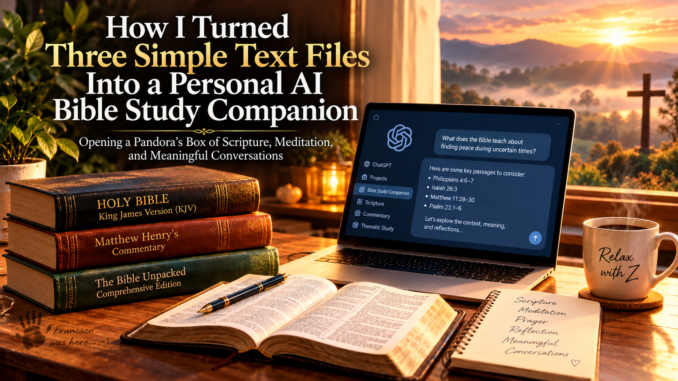
AI Bible Study: How I Built My ChatGPT Bible Companion
Opening a Pandora’s Box of Scripture, Meditation, and Meaningful Conversations.
Before You Begin: A Personal Note
For this experiment, I recommend using a paid ChatGPT Plus subscription and enabling Voice Mode. In my personal experience, speaking naturally with an AI Bible study companion creates a richer, more engaging experience than typing alone. Voice availability and usage limits vary by plan and may change.
Proceed at your own risk and exercise personal spiritual discernment. AI can make mistakes and should never replace Scripture, pastoral guidance, professional mental health care, or your personal relationship with God. Please read the full disclaimer at the bottom of this article before beginning.
And here’s a little challenge from me: If you have access to a Pastor, Minister, or church elder who has spent decades studying Scripture, invite them to experience a demonstration. Ask a meaningful biblical question, explore the supporting passages together, and observe their reactions.
I did. And that experience became part of the inspiration for sharing this discovery with you.
Remember, the goal is not to prove that AI knows more than a person of faith. It is to discover how technology might help us explore the Bible together. (Note I tried to replicate this experiment with other AI Tools, to be fair, but so far getting errors saying the KJV file is too large…)
=========================================================
I warned you…
Sometimes the most meaningful discoveries begin with something surprisingly simple. In my case, it was three ordinary text files, a ChatGPT Project, and a question about the Bible.
I wasn’t trying to build a sophisticated application, launch a religious platform, or replace my relationship with God. I simply wanted to explore Scripture through conversation. What began as a small experiment opened what I can only describe as a Pandora’s box of biblical questions, meditation, reflection, and unexpected discoveries.
One question led to another. Forgiveness led to love. Prayer opened conversations about grief, relationships, discernment, and the meaning of life. Before long, I had a personal AI Bible study companion that helped me explore the resources I had collected and organize my thoughts.
And I didn’t write a single line of code.
Today I want to share how I did it, what I learned, and how you can create your own study space.
Why I Wanted More Than a Traditional Bible Search
Sometimes we know exactly which verse we want. Other times our questions are more complicated:
- What does Scripture teach about loving someone while maintaining boundaries?
- How do forgiveness and reconciliation differ?
- How can we approach grief, loneliness, patience, or uncertainty?
Such questions invite us to explore multiple passages, consider interpretations, and admit that we may not yet have a complete answer.
My own curiosity about Scripture had already taken me through a personal journey of discovery, which I shared in 10 Things I Learned Reading the Gospel of Luke.
With conversational AI, I could ask a question, request supporting passages, challenge an explanation, and continue exploring. It felt less like searching a database and more like an extended study conversation.
But conversation alone is not enough.
AI can misunderstand passages, invent references, or sound more certain than it should. I wanted the conversation connected to actual materials.
That led me to three text files.
The Three Files That Opened the Door
1. The King James Version (KJV)
My first file contains the King James Version of the Bible. It is my primary biblical reference.
When discussing a passage, I want to begin with what the text says, examine its context, and consider its meaning before jumping to modern advice.
This approach connects with something I explored in Read the Manual: A Sunday Reflection on Slowing Down, Scripture, and Peace.
Sometimes we need to return to the original instructions instead of rushing toward our own conclusions.
2. Matthew Henry’s Commentary
The second file contains Matthew Henry’s commentary. It offers historical Christian interpretation, explanations, and devotional reflections.
It is useful when I want to explore how a Christian commentator understood a teaching.
Yet commentary is not Scripture. Henry’s words are a human interpretation and should be identified as such.
3. The Bible Unpacked — Comprehensive Edition
The third resource organizes biblical teachings thematically.
It helps me explore subjects involving multiple passages, such as prayer, love, or wisdom. Its organization complements the biblical text and commentary rather than replacing either one.
Together, the resources establish a simple structure:
- Scripture: The foundation.
- Commentary: Historical interpretation.
- Thematic study: Connections between related teachings.
Plain-text files are easy to upload and require no special document software.
Obtain resources from legitimate sources and respect their licensing terms. Different editions and supporting works may have different rights.
How to Create Your Own ChatGPT Bible Study Project
You do not need to be a programmer to create your own study companion.
Step 1: Create a Project
Open ChatGPT, find Projects, and create a new one.
Choose a name such as “My Bible Study Companion” or “Scripture and Reflection.”
A Project keeps related conversations, files, and instructions together.
Step 2: Gather Your Materials
Begin with a Bible translation you trust.
Add commentaries or thematic study guides that you are authorized to use.
Know what each resource represents. A translation, a commentary, and a topical guide do not carry the same role.
Step 3: Upload the Files
Use the Project’s file-upload option to add the resources.
ChatGPT can use them as references, but uploading does not guarantee perfect retrieval of every passage, especially in large files.
Always verify important quotations and references.
Step 4: Add Clear Project Instructions
You can copy and adapt the following template:
You are my Bible study and reflection companion.
Use the Bible translation uploaded to this Project as the primary biblical reference. Use commentaries and thematic study resources as supporting materials.
When answering questions:
- Identify relevant Bible passages by book, chapter, and verse.
- Clearly distinguish biblical text from commentary and your own explanation.
- Explain passages in literary and historical context when possible.
- Do not invent quotations, references, or source material.
- If a file or passage cannot be accessed or verified, say so clearly.
- Acknowledge when Christian traditions interpret a passage differently.
- Encourage me to verify important passages using a physical Bible or trusted edition.
- Offer thoughtful reflection questions when appropriate.
- Help me explore prayer and meditation without claiming to speak for God.
- Never present yourself as a pastor, prophet, divine authority, or replacement for personal spiritual discernment.
Maintain a respectful, thoughtful, compassionate conversational tone. Support my learning without pressuring me toward a particular interpretation.
Step 5: Begin With One Question
Try asking:
“What does the Bible teach about finding peace during uncertain times?”
Ask for passages, context, and a clear separation between biblical text and commentary.
Then ask follow-up questions.
When something seems uncertain, return to the original source.
When the Pandora’s Box Opened
I discovered that Bible study rarely stays within one question.
Love can lead to marriage, commitment, forgiveness, and boundaries. Grief can lead to hope and prayer. Creation can lead to conversations about science, faith, and the universe.
Sometimes the most interesting moment is not the first answer but the next question.
I could ask something simple without embarrassment, revisit a passage, request a different explanation, and compare the biblical text with Matthew Henry before forming my own understanding.
The process reminded me that studying Scripture is not about collecting quick answers.
Sometimes it is about having the patience to sit with a question.
Technology did not create my curiosity. It gave me another way to explore it.
Five Bible Study Prompts You Can Try Today
If you want to begin your own experiment, here are five practical starting points.
1. Understanding a Passage
“Using my uploaded Bible resources, help me understand Matthew 6:25–34. Explain it in context, distinguish Scripture from commentary, and suggest three reflection questions.”
2. Exploring Forgiveness
“What does the Bible teach about forgiveness? Identify relevant passages and explain how forgiveness relates to reconciliation and personal boundaries.”
For a complementary reflection on approaching ourselves with patience and kindness, you may also enjoy Self-Compassion Meditation for Beginners.
3. Comparing Scripture and Commentary
“Show me what the biblical text says about this subject. Then explain how Matthew Henry interprets the relevant passages. Clearly distinguish his commentary from Scripture.”
4. A Five-Minute Scripture Meditation
“Guide me through a gentle five-minute meditation based on Psalm 23, including a short reading, reflection, quiet pauses, and a closing prayer grounded in Scripture.”
5. Faith in Everyday Life
“Help me explore what Scripture teaches about responding to uncertainty with faith, patience, and wisdom. Identify relevant passages and suggest practical reflection questions.”
These are starting points, not substitutes for your judgment.
Modify them, ask follow-up questions, and check the sources.
From Bible Study to Meditation and Prayer
One meaningful part of this experiment has been seeing how naturally study can lead into meditation.
At Relax with Z, I value stillness, reflection, and intentional living. Scripture offers a foundation for that practice.
Consider Psalm 23.
Read it slowly. Ask about its context and shepherd imagery. Explore related passages about trust and guidance.
Then reflect:
- Where do I need patience?
- What might peace look like even when circumstances remain uncertain?
- How can I carry this passage into my day?
You can also write your reflections in a notebook. My guide to Prayer Journaling for Beginners explores a simple way to bring prayer, gratitude, and reflection together.
You do not need technology for the final part.
Close the laptop if you wish.
Sit quietly.
Breathe naturally.
Pray.
If you prefer a little guidance while settling into stillness, you can explore our 10-Minute Guided Meditation to Clear Your Mind.
And if closing your eyes is uncomfortable, meditation does not have to look a certain way. Our guide to Meditating With Your Eyes Open offers another gentle approach.
The conversation may help organize your thoughts, but your time with God remains your own.
Important Boundaries: AI Is a Tool, Not a Spiritual Authority
This is the most important lesson I want to share.
AI can be an educational tool, but it is not a pastor, prophet, spiritual authority, or substitute for discernment.
It does not receive divine revelation or determine God’s personal will for your life.
Even when it sounds confident, it can make mistakes.
Verify quotations and references against a physical Bible or trusted edition.
Know whether you are reading Scripture, a historical commentator, or an AI-generated explanation.
Recognize that Christian traditions interpret some passages differently.
Protect your privacy when sharing personal stories.
For significant spiritual questions, consider a trusted pastor, priest, or qualified adviser. Seek appropriate professionals for medical, legal, or financial concerns.
Above all, do not confuse a generated response with God’s voice.
I believe wisdom should be approached with humility before God.
Technology may help us study, but faith, prayer, discernment, and our decisions remain our responsibility.
An Invitation to Begin Your Own Conversation
When I started, I had no idea how far three simple files would take me.
These conversations have even inspired a book I am developing.
It is not finished, and I am not rushing it. But I do not need to wait for the book to be ready before sharing the discovery.
Perhaps you have a question you have carried for years.
Perhaps you want to rediscover the peaceful practice of sitting with an open Bible.
Begin with one passage.
Ask one question.
Follow your curiosity.
You can disagree with an AI explanation, request clarification, and return to Scripture itself.
Tomorrow I will be joined by my AI conversation partner, Princess Aiko, for a two-host Relax with Z podcast about how this experiment began, what we discovered, and why human discernment must remain at its center.
If you enjoy thoughtful conversations about faith, meditation, and everyday life, I invite you to subscribe to Relax with Z on YouTube and join us for the conversation.
And if you enjoy peaceful music while reading, journaling, or simply slowing down, you can also listen to Christmas with Z, my collection of gentle Christmas music. Because sometimes the spirit of Christmas belongs in September, too.
For my other music, videos, books, and creative projects, you can find everything in one place here.
And now, one final question for you.
If you could ask one question about the Bible today, what would it be?
Take your time.
The conversation is just beginning.
With gratitude,
Francisco
Relax with Z
Educational and Spiritual Disclaimer
The content provided by Relax with Z, including articles, podcasts, meditation recordings, and AI-assisted Bible study materials, is intended for educational, informational, and personal reflection purposes only.
Our content does not constitute medical advice, psychological treatment, psychiatric care, professional counseling, or individualized spiritual direction.
Artificial intelligence is a technological tool. It is not a human being, licensed therapist, pastor, prophet, divine messenger, or spiritual authority. AI-generated responses may contain errors, inaccurate biblical references, or interpretations that do not reflect your personal faith tradition.
Readers are encouraged to verify Scripture independently, exercise personal discernment, and consult trusted religious leaders when appropriate.
Mental Health and Emotional Well-Being
If you are experiencing depression, severe anxiety, emotional distress, unusual perceptions, or difficulty distinguishing reality from AI-generated conversations, please seek guidance from a qualified healthcare or mental health professional.
Do not rely on AI conversations, meditation recordings, or spiritual content as substitutes for professional diagnosis, treatment, prescribed medication, or human support.
AI-generated statements should never be interpreted as personalized messages from God, supernatural instructions, or evidence of a special spiritual mission.
Prayer, meditation, and faith-based reflection may complement appropriate professional care, but they should not replace it.
Crisis and Emergency Support
If you or someone you know is experiencing thoughts of suicide, self-harm, or a mental health crisis, seek immediate human assistance.
United States: Call or text 988 to reach the Suicide & Crisis Lifeline, available 24 hours a day.
Immediate danger: Call 911 or go to the nearest emergency department.
Outside the United States, contact your local emergency services or an appropriate crisis support organization.
Personal Responsibility
By using these materials, you acknowledge that AI-generated information requires independent verification and that personal decisions regarding faith, health, relationships, and well-being remain your responsibility.
Relax with Z encourages thoughtful exploration, personal discernment, healthy human relationships, and appropriate professional support.
Our guiding principle: Technology may support reflection, but it should never replace Scripture, human connection, professional care, or your personal relationship with God.