How to Create a 5-Minute “Arrival Ritual” After Work (No Meditation Experience Needed)
How to Create a 5-Minute “Arrival Ritual” After Work (No Meditation Experience Needed)
You know that feeling when you finally get home from work, and you’re home, but you’re not really home yet?
Like, physically you’re there. You’ve walked through the door. Maybe you’ve even changed into sweatpants. But mentally? You’re still stuck in that meeting from three hours ago, or replaying that weird email, or just feeling this low-level buzz of “on” that won’t quite turn off.
Your evening stretches ahead of you—time to relax, right?—but instead you find yourself scrolling, snacking without really tasting anything, or sitting on the couch feeling tired but restless at the same time.
Here’s what nobody tells you: the problem isn’t your evening. It’s the three seconds between work and evening that you’re skipping entirely.
The Invisible Gap Between Work and Home
Most of us move from work mode to home mode like we’re changing channels—instant, automatic, no transition needed.
Except our brains don’t actually work that way.
Your nervous system doesn’t have a switch. It has gears. And if you’ve been in work gear for eight hours—problem-solving, responding, staying alert, managing a thousand tiny decisions—your body needs an actual signal that it’s safe to shift down.
Without that signal? You bring work home with you. Not the laptop or the emails. The energy. The vigilance. The low-grade tension that makes you feel like you’re still waiting for something to happen.
And then you wonder why you can’t relax even though you’re “supposed to” be relaxing.
This isn’t about discipline or having a better routine. It’s about giving your body a chance to catch up to the fact that work is actually over.
If you like gentle structure, you may also enjoy:
an evening mindfulness routine that keeps things simple and beginner-friendly.
What an “Arrival Ritual” Actually Is
Let’s be clear about what we’re talking about here, because the word “ritual” can sound a little… much.
This isn’t meditation. It’s not breathwork or journaling or lighting sage while setting intentions for your abundant evening.
An arrival ritual is just a short, repeatable pause that marks the end of work mode. That’s it.
It’s sensory. It’s simple. And it doesn’t require you to be good at calming down or “doing it right.”
Think of it less like self-care and more like… closing a door. You’re not trying to transform yourself. You’re just signaling to your nervous system: this part is done. You can stop now.
The magic isn’t in the steps themselves. It’s in the consistency. Your body starts to recognize the pattern—“Oh, we’re doing this thing again. That means work is over. I can ease up now.”
It’s Pavlovian, honestly. Except instead of a bell and a treat, it’s a candle and the permission to finally exhale.
The 5-Minute Arrival Ritual (Here’s How It Works)
Okay, here’s the actual structure. You can adjust this to fit your life, but the key is keeping it simple and keeping it the same every single day.
Minute 1: Arrival Pause
When you first get home—whether that’s walking through your front door or closing your laptop if you work from home—don’t do anything yet.
Don’t immediately change clothes, don’t start dinner, don’t check the mail, don’t greet anyone, don’t turn on the TV.
Just… pause.
Stand there. Sit down. Lean against the counter. Whatever feels natural.
Let your body register: I’m here now.
That’s it. You’re not meditating. You’re not clearing your mind. You’re just giving yourself five seconds to arrive instead of bulldozing straight into the next thing.
Minute 2: Physical Unloading
Now you get to move, but slowly.
Take off your shoes. Put your bag down. Set your keys in the same spot you always set them. Hang up your coat. Put your work stuff away—laptop closed, badge off, whatever you carry.
These aren’t just practical actions. They’re signals.
Your nervous system speaks the language of the body. Small, deliberate physical actions tell it: “Work is over. We’re safe. We can let go now.”
This is why changing out of work clothes can feel so good. It’s not about comfort. It’s about marking a boundary.
Minute 3: Sensory Anchor
This is the part that makes it a ritual instead of just… arriving home.
Pick one simple sensory thing and do it every single time.
- Light a specific candle
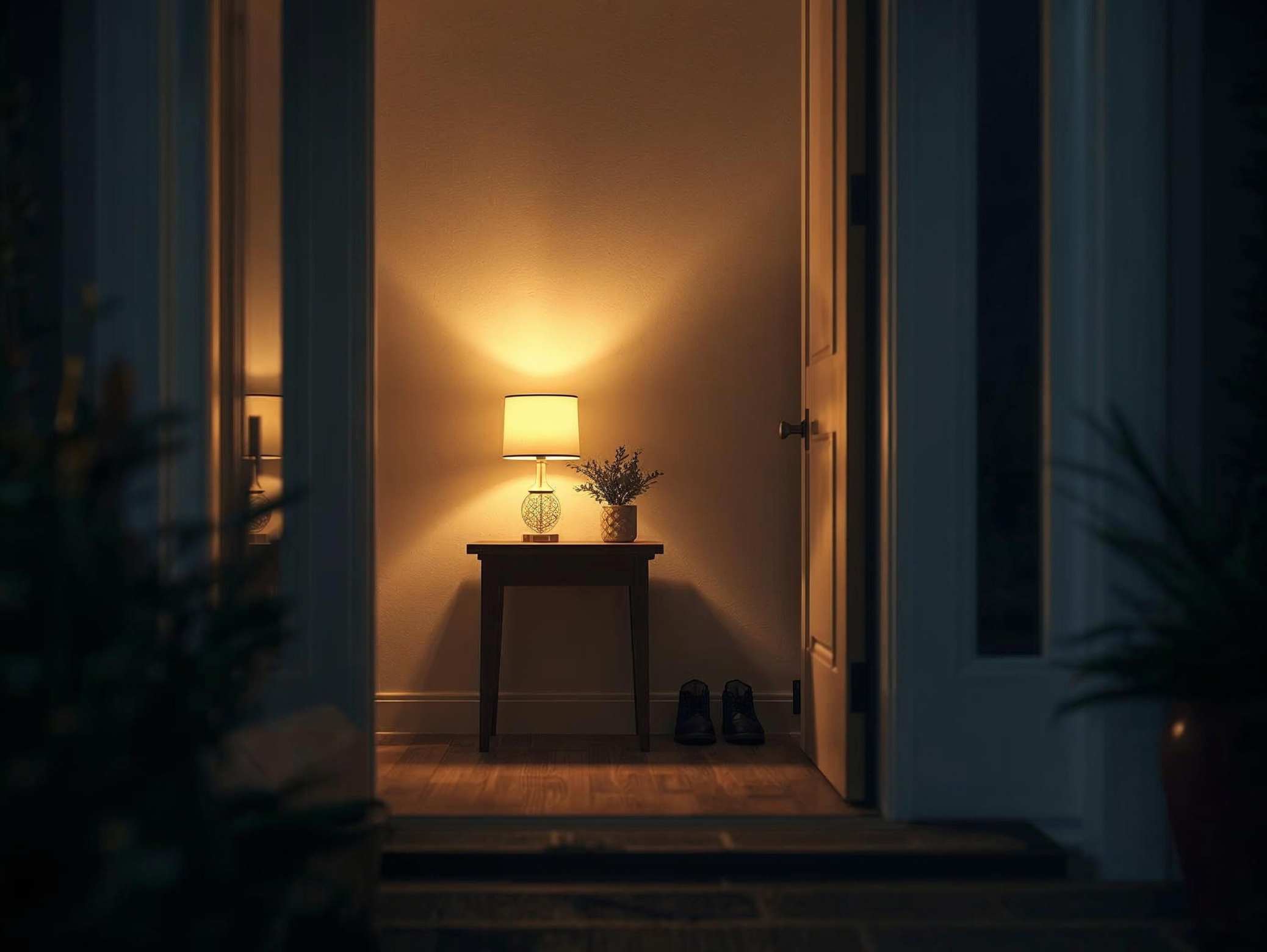
- Turn on a specific lamp (not the overhead—something softer)
- Play a specific song or playlist
- Open a window
- Wash your hands with a specific soap
- Make a cup of tea (same mug, same tea)
- Change into a specific sweater or hoodie
It doesn’t matter what you pick. What matters is that it’s the same every day.
Over time, your brain will start to associate this sensory cue with “work is done, home is starting.” It becomes automatic. The calm doesn’t come from the candle itself—it comes from the repetition, the predictability, the this again of it.
Want an even simpler anchor? Try a simple breathing practice you can pair with your lamp/candle cue.
Minute 4: Gentle Attention Reset
Now, just notice something.
Not in a mindfulness-y way. Just… look around and actually see one thing. Or listen and actually hear one sound. Or feel the temperature of the air on your skin.
- The light coming through the window
- The hum of the fridge
- The texture of the chair you’re sitting in
- The sound of a car passing outside
- The coolness of the floor under your feet
You’re not trying to be present or zen. You’re just… here. Noticing one small thing that’s happening right now, in this room, in your actual life.
No reflection. No gratitude journaling. No “what does this mean.”
Just: oh, that’s a thing I can see/hear/feel.
This pulls your attention out of work mode (which lives in your head) and into home mode (which lives in your senses).
If you’re brand new to this style of settling, you might also like these calming techniques for beginners (zero fluff, zero pressure).
Minute 5: Intentional Release
Last step.
Say to yourself—out loud or just in your head—something like:
“Work stays there. I’m here now.”
Or:
“That part is done.”
Or even just:
“Okay.”
It doesn’t have to be profound. It just has to be intentional.
You’re drawing a line. Work happened. It’s over. You’re allowed to stop carrying it.
Then, take one full breath if that feels right. Or don’t. Whatever.
Now you’re done. Go do whatever you were going to do—make dinner, collapse on the couch, talk to your family, stare at the wall. But you’ve arrived first.
What If Your Life Doesn’t Look Like This?
I know what you’re thinking. “That’s nice, but I live in a 400-square-foot studio” or “I have kids who need me the second I walk in” or “I work from home—there’s no door to walk through.”
Fair. Here are some real-life variations:
If you have a small apartment
You don’t need a separate room or a fancy entryway. Use a corner. Use a chair. Use the kitchen counter. The “arrival spot” can be anywhere as long as it’s consistent.
You can also use sound or lighting to create a boundary—change the music, turn off the bright light and turn on a lamp, open a window. Your brain will learn to recognize the shift.
If you have kids or roommates
You don’t have to disappear. You can say, “Hey, I just need five minutes to land—be right with you.” Most people get it.
You can even do a shortened version where you just take off your shoes, light the candle, and take one breath before diving in. Or involve them: “Let’s all take our shoes off together.” Kids often love rituals.
If you work from home
This one’s tricky because there’s no physical transition. You have to create an arrival.
- Close your laptop and step outside for 30 seconds, then come back in
- Walk around the block
- Change rooms
- Change clothes
- Sit in a different chair
The key is changing context, not location. Your body needs a marker that says “work me is done, home me is starting.”
If you work irregular hours or shifts
The ritual works at any time of day. If you get home at 2 a.m. or 3 p.m., it doesn’t matter—keep the structure the same. Your nervous system doesn’t care what the clock says. It cares about consistency.
Mistakes That Make It Not Work
Real quick—here are the ways people accidentally sabotage this:
- Trying to relax too fast. You can’t force calm. If you rush through the ritual trying to feel peaceful right now, you’re just adding pressure.
- Turning it into a checklist. If you start grading yourself on how “well” you did the ritual, you’ve missed the point.
- Skipping it on busy days. These are the days you need it most. Five minutes now saves you fifty minutes of restless scrolling later.
- Expecting instant results. The first few times, it might feel like nothing. That’s normal. The ritual builds over time.
- Making it too complicated. More steps doesn’t mean more calm. Keep it simple. Keep it the same.
How to Make It Automatic (Without Needing Willpower)
Here’s the thing: motivation runs out. Willpower is exhausting. If you rely on either of those to maintain this ritual, you’ll quit in a week.
Instead, make it automatic.
- Tie it to something you already do. The moment you turn your key in the lock, that’s the cue. The moment your shoes come off, that’s the cue. The second you close your laptop, that’s the cue.
- Keep it identical. Same spot, same sensory cue, same order. Every. Single. Day.
- Let it end naturally. Don’t set a timer. Don’t rush. You’ll know when the five minutes are up because your body will feel… done.
- Make it easy on yourself. Remove friction: keep the lighter next to the candle, keep the mug visible, keep your “arrival spot” clear.
And here’s the weird part: after a couple weeks, you won’t have to think about it anymore. You’ll walk in the door, take off your shoes, light the candle, and your body will just… sigh. It’ll know what’s happening.
That’s when you know it’s working.
Why This Matters More Than You Think
Look, I’m not going to promise this will change your life or make your evenings perfect or fix your stress.
But here’s what it does do: it gives you a boundary between work and rest.
And most of us don’t have that anymore. We go from Zoom call to couch in eight seconds flat. We carry the energy of the day all the way to bedtime and wonder why we can’t sleep.
Calm evenings don’t start at bedtime. They start the second you get home.
This ritual isn’t about adding more to your plate. It’s about giving yourself permission to stop. To mark the end of one thing before starting the next. To let your body catch up to your life.
You don’t need an hour-long evening routine. You don’t need a meditation practice or a yoga mat or a better mindset.
You just need five minutes at the door.
Try it tonight. Imperfectly. With no expectations. Just walk in, pause, and see what happens.
Want to support the calm vibe long-term? Pair this with slow living habits and small tweaks for creating a peaceful home that make “arriving” feel easier every day.