The 2-Minute “Bathroom Reset”: A Private Calm Routine You Can Do Anywhere
The 2-Minute “Bathroom Reset”: A Private Calm Routine You Can Do Anywhere
You know that moment when everything feels like too much and you just need to disappear for a second?
Not dramatically. Not forever. Just… away from the noise and the people and the questions and the everything for one minute where nobody needs anything from you.
Here’s the thing nobody talks about: the bathroom is the last truly private space most of us have access to on a regular basis.
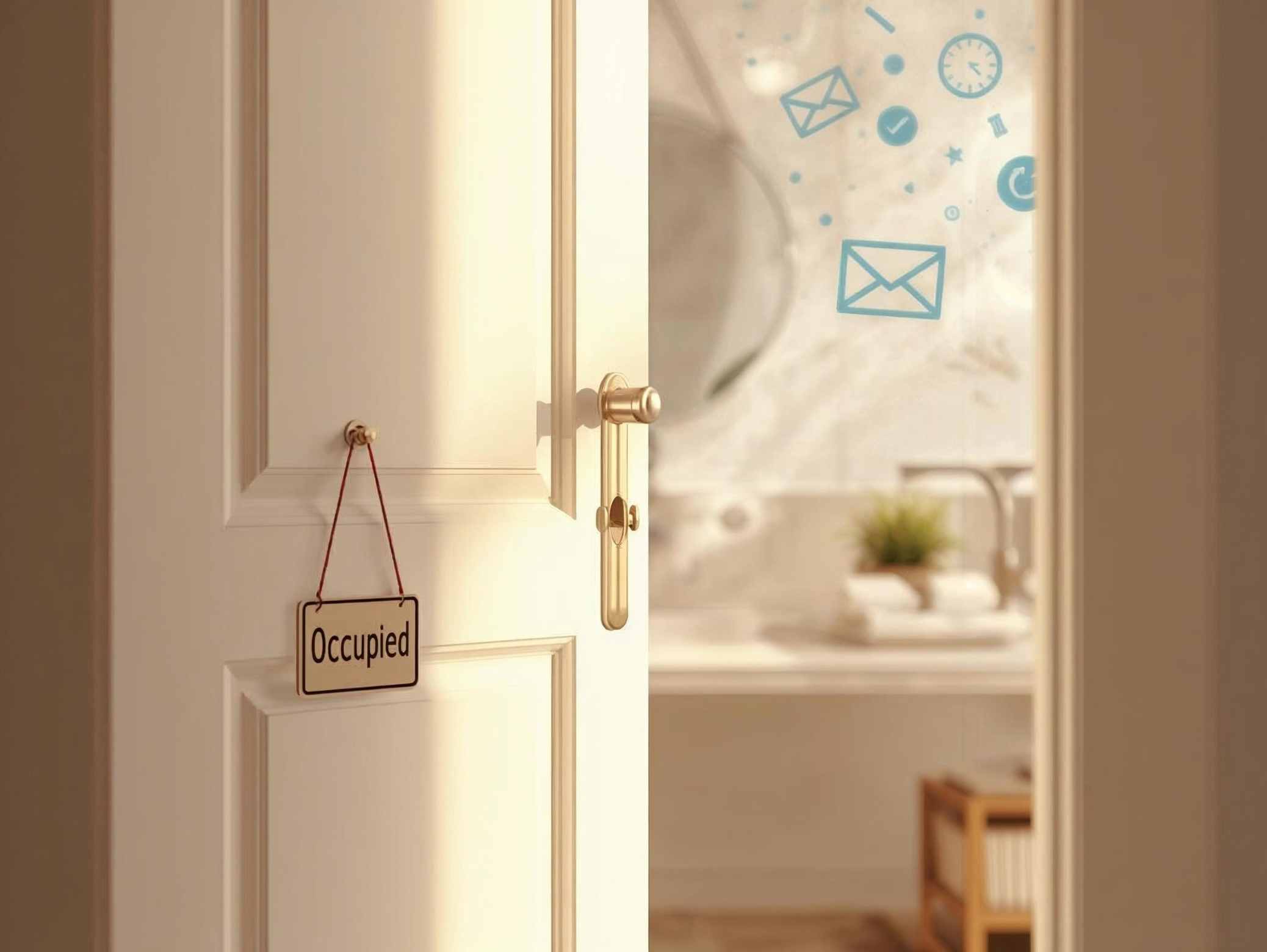
It’s the one place where you can lock a door and the world legally has to stay on the other side. Your boss can’t follow you in. Your kids aren’t allowed. The person hosting the party you’re at can’t ask you to “just quickly” do something.
And that makes it the perfect place for a secret little reset that nobody needs to know you’re doing.
This isn’t about self-care or treating yourself or any of that. This is about survival. This is about those days when you can feel the overwhelm creeping up your spine and you know you need something before you snap—but you don’t have time for a meditation app or a walk around the block or whatever else people suggest when they don’t understand that you’re barely holding it together.
You just need two minutes. Behind a locked door. Where no one can see you.
Let me show you how.
Why Private Resets Actually Work
There’s something that happens to our nervous system when we know we’re truly alone and no one is watching.
It drops.
Not completely. Not into some blissful zen state. But that constant low-level vigilance—the part of you that’s tracking the room, managing your facial expressions, staying ready to respond—it eases up just a little.
Because here’s the truth: most of us spend our entire day on.
On for our coworkers. On for our families. On for the stranger at the coffee shop who’s making small talk while you’re just trying to get caffeine. On for the group chat. On for the Zoom call. On for the person who definitely saw you in the grocery store and is now walking toward you.
And the bathroom? The bathroom is the only socially acceptable “do not disturb” sign we have left.
Nobody questions it. Nobody follows up with “can you just quickly—” while you’re in there. Nobody asks what took so long (or if they do, the question answers itself and they immediately regret asking).
It’s a built-in two-minute window where the world has agreed to leave you alone.
And you can use that.
Not to scroll on your phone or check email or do anything productive. Just to… stop. To let your nervous system realize that nothing is actively on fire right this second. To take the shortest possible break from being perceived.
Here’s the other thing: micro-resets like this work better than you’d think.
We’ve all been sold this idea that rest needs to be big. A spa day. A vacation. A full weekend of doing nothing. And sure, those things are nice. But they’re also rare.
If you’re waiting for the perfect 20-minute window to do a guided meditation, you’re going to be waiting a long time.
Two minutes? You have two minutes. You have it right now. You’ll have it again later today.
And the beautiful thing about these tiny resets is that they’re repeatable. You’re not trying to fix everything at once. You’re just putting a small pause between you and the chaos so you don’t get completely swept away by it.
It’s maintenance, not transformation. And honestly? That’s more useful.
Related reads: If you like quick, realistic tools like this, you may also enjoy these quick mindfulness exercises and this simple guide to mindfulness at work.
When You Actually Need This
Let me paint you a picture.
You’re at work. You’ve been in back-to-back meetings for three hours. Someone just sent an email with the subject line “quick question” that is definitely not a quick question. Your calendar says you have 12 minutes before the next thing. You can feel the tightness starting in your chest, that feeling like the walls are slowly moving closer together.
You don’t need a therapist. You don’t need a vacation. You need 90 seconds where no one is talking at you.
Bathroom. Lock the door. Breathe.
Or: you’re at a family gathering. You love these people, you do, but someone just asked you for the third time when you’re having kids / getting married / buying a house / changing careers, and the noise level has reached that point where you can’t actually hear individual conversations anymore—just this wall of sound that’s making your brain feel like static.
You don’t want to be rude. You don’t want to leave. You just need the volume to stop for one minute.
Bathroom. Lock the door. Silence.
Or: you work from home. You just closed your laptop after eight hours of staring at it. Your “commute” is twelve steps to the couch. There’s no transition. No decompression. No space between work-you and home-you. And you can feel work-you bleeding into the evening, making you irritable and restless and unable to actually relax even though you’re technically “done.”
You need a reset button.
Bathroom. Lock the door. Shift gears.
Or: you’re traveling. The airport is chaos—fluorescent lights, gate announcements, delays, crying children, people standing too close, that weird Airport Anxiety that makes everything feel urgent even though you’re literally just sitting there waiting.
You need to feel like a person again instead of a passenger.
Bathroom. Lock the door. Ground yourself.
The point is: this isn’t about one specific scenario. It’s about that feeling. That too much feeling. The one where you’re still functioning but you can feel yourself fraying at the edges.
That’s when you go lock yourself in a bathroom for two minutes.
Not because you’re broken. Not because you’re failing at life. Just because you’re a human being with a nervous system that needs a beat to recalibrate.
The Actual 2-Minute Reset (Here’s What You Do)
Alright, here’s the structure. You can adapt this however you need to, but the basic idea is the same: use the privacy and the quiet to give your body a chance to stop performing.
Step 1: The Lock as a Cue
Walk into the bathroom. Close the door. Lock it.
That click—the sound of the lock sliding into place—let that be your signal.
Work is on the other side of that door. The party is on the other side. Your family, your inbox, your to-do list, all of it. On the other side.
In here? Just you.
Feel your shoulders drop. They were up by your ears—they always are—and now they can come down. Half an inch. That’s all. You don’t have to force it. Just let the lock be the cue that you can stop holding everything up for a second.
Step 2: Grounding Through Touch
Put one hand on the sink. Or the counter. Or the wall. Somewhere solid.
Feel it. Actually feel it.
Is it cool? Smooth? Slightly textured?
This isn’t some mystical energy work. It’s just reminding your body that you’re standing on actual ground in an actual room, not free-falling through your own anxiety.
The physical world is real and steady, and you are in it. You are not, despite what your nervous system might be telling you, currently in danger.
You’re in a bathroom. With a locked door. And everything is, for this exact moment, fine.
Want more beginner-friendly grounding? Here are simple grounding techniques for beginners you can use anywhere (not just in bathrooms).
Step 3: The Un-Forced Breath
Here’s where people usually get tripped up because they think this is where the bathroom breathing exercise starts.
It’s not.
You don’t have to breathe in for four, hold for seven, out for eight. You don’t have to do box breathing or belly breathing or any kind of special breathing.
Just notice that you’re breathing.
Where is the air going? Chest? Stomach? Is it shallow? Deep? Fast? Slow?
It doesn’t matter. You’re not trying to fix it. You’re just paying attention to it.
Let it be messy. Let it be shallow. Let it be whatever it is.
You’re not doing this to make yourself calm. You’re doing it to remind yourself that your body is still doing the basics, even when your brain is spinning out.
If you want a gentle “next step”: try this calming breathing practice when you have a little more time.
Step 4: The White Noise Anchor
Most bathrooms have some kind of background noise.
The fan. The hum of fluorescent lights. The distant sound of plumbing. The muffled noise of people on the other side of the door. Maybe a drip from the faucet.
Pick one sound and let it hold your attention.
Not forever. Just for a few seconds.
Let it be boring. Let it be repetitive. Let it fill the space where your anxious thoughts usually live.
This is what people mean when they talk about mindfulness, except without all the pressure to do it right. You’re just… listening to a bathroom fan. That’s it. That’s the whole technique.
And somehow, it works.
Step 5: The Internal Permission Slip
This is the last part, and it’s the simplest.
Say something to yourself. Out loud or just in your head. Something like:
- “For these two minutes, I don’t have to solve anything.”
- “Nothing is on fire. I can be still.”
- “I’m allowed to be here.”
Because here’s the thing: a lot of us feel guilty for taking breaks. Even two-minute ones. Even in the bathroom where we’re literally supposed to be.
So this is your permission slip. You’re allowed. You needed this. It’s fine.
Say it once, then let it go. You don’t have to believe it. You just have to hear it.
What If Breathing Feels Like Work?
Okay, real talk: some days, focusing on your breath makes things worse, not better.
If your chest is tight and someone tells you to “just breathe,” it can feel condescending. Or impossible. Or like one more thing you’re failing at.
So here’s a version that doesn’t involve breath at all.
The Temperature Reset
Turn on the cold water. Run it over your wrists for 10–15 seconds. Feel the temperature. Let it shock your system just a little—not in a bad way, in a “oh right, I have a body and it can feel things” way.
Or splash cold water on your face. Or press a wet paper towel to the back of your neck.
Temperature is one of the fastest ways to regulate your nervous system, and it doesn’t require you to think about it or do it correctly.
The 3-Object Scan
Look around the bathroom and silently name three things you can see.
The tile pattern. The door hinge. The paper towel dispenser.
Then three things you can hear. The fan. Distant voices. The hum of the building.
Then three textures you can feel. The cool sink. The fabric of your shirt. The floor under your shoes.
This pulls your brain out of the spiral and into the present.
The “Just Stand Here” Option
Sometimes you don’t need a technique.
Sometimes you just need to stand still in a quiet room for 90 seconds and stare at the wall.
No method. No trying. Just existing in a space where no one needs anything from you.
Your nervous system will do the rest.
How to Walk Back Out Without Falling Apart
Alright, you’ve had your two minutes. Now you have to go back out there.
Here’s the thing: you’re not going to walk out of that bathroom glowing with inner peace. You’re not enlightened. You didn’t solve anything.
But you also didn’t send that angry text. You didn’t cry in front of people. You didn’t quit your job or snap at someone you love or spiral into a full panic attack.
You just… paused. And that’s enough.
Wash your hands slowly. Not because you’re trying to extend the reset, but because it’s a nice little closing ritual. Feel the soap. Feel the water. Feel the towel.
Look in the mirror (if you want). Not to fix your face or check if you look like you’ve been crying. Just to make eye contact with yourself for a second.
Take the calm with you. It’s not going to last forever. Maybe it only lasts five minutes. Maybe ten. But that’s five minutes you didn’t have before.
If you like these “micro” tools, you’ll probably also like this mini reset routine for everyday overwhelm.
Making This an Actual Thing You Do
Here’s how you remember this exists:
You don’t schedule it. You don’t put it on your calendar or make it a daily habit or add it to your routine.
You just remember, the next time you feel that clench in your jaw or that heat rising in your chest or that fog creeping into your brain:
“Oh right. I can lock myself in a bathroom for two minutes.”
And then you do.
If someone knocks and you only get 30 seconds, those 30 seconds still count.
If you spend the whole two minutes thinking about your to-do list instead of being present, it doesn’t matter. You still took two minutes where you weren’t actively doing the to-do list.
If you feel silly the first time you try this, do it anyway. Feeling silly is better than feeling like you’re going to scream.
This isn’t self-improvement. It’s not something you can fail at.
Most people white-knuckle it until they break. You’re not doing that. You’re catching yourself before the break. That’s the whole win.
The Truth About Needing This
If you’re reading this and thinking, “Is it weird that I need to lock myself in a bathroom just to feel okay?”
No. It’s not weird.
It’s not a sign that you’re broken or failing or doing life wrong.
It’s a sign that you’re paying attention. That you know your limits. That you’re doing something about the overwhelm before it turns into a full meltdown.
Most people don’t do that. Most people just push through until they can’t anymore, and then they wonder why they snapped at someone they love or cried at their desk or rage-quit something important.
You’re being smart. Strategic, even.
And the best part?
Nobody has to know.
Try a 5-Minute Practice
If you want to build on this (gently, without turning it into a “project”), try a longer reset next:
Try a 5-minute practice when you have a little extra breathing room—before your day gets loud again.
Two minutes keeps you steady. Five minutes helps you come back to yourself.