The “Lamp Light Pause”: A Gentle Evening Habit to Shift Into Rest Mode
The “Lamp Light Pause”: A Gentle Evening Habit to Shift Into Rest Mode
A simple, calming ritual using warm light to help your nervous system ease from the day into restful evening.
Introduction — The Moment the Day Softens
There is a particular quality to the hour after work ends or the children settle — a kind of suspended moment when the demands of the day have technically stopped, but the mind has not quite caught up with that fact. You might be sitting on the sofa, or standing in the kitchen waiting for the kettle, or scrolling through your phone without really looking at anything. The day is over, but it is still very much present.
This is not unusual. Modern evenings rarely include a clear, deliberate transition between the pace of the day and the quietness of the night. Instead, we tend to move from one kind of activity to another — from work tasks to domestic ones, from one screen to another — until at some point we find ourselves horizontal in bed, waiting for sleep to arrive, with a mind that has received no signal that anything has changed.
The result is familiar to most people: lying awake with a low hum of unfinished thoughts, a body that is tired but a mind that is still running, still processing, still alert to everything it did not finish. We have moved the body into a sleep position, but we have not actually transitioned into a sleep state. We have closed the browser tabs without shutting down the machine.
What is missing is a cue. Not a dramatic one, and not a lengthy one — just a small, reliable signal to the nervous system that the day’s work is done, that nothing more is required, and that it is now safe to release the alertness that has been holding everything together. The body is very responsive to such signals when they are given consistently and gently. It simply needs to be told.
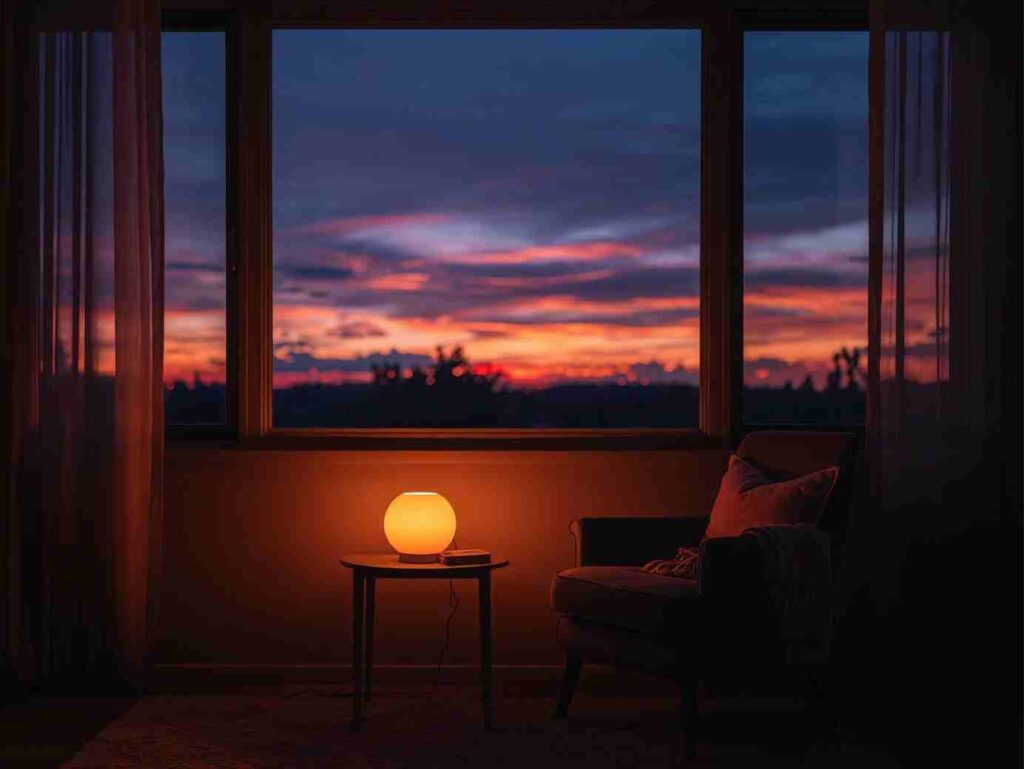
This is the idea behind the Lamp Light Pause: a short, intentional evening habit built around one of the most natural and available cues available — the quality of light in the room. By switching from bright overhead lighting to a single warm lamp, and sitting with that change for just a few minutes, you give your nervous system a clear, repeated signal: the day is slowing down. It is not a productivity routine. It is not a wellness protocol with ten steps and a tracking spreadsheet. It is just a small, gentle ritual — a few minutes of soft light and quiet attention — that can shift the tone of an entire evening.
1. Why Lighting Influences Mental Pace
Most of us understand, at least in the abstract, that light affects mood and sleep. But the mechanism is worth understanding more concretely, because it explains why a seemingly small change — turning off an overhead light and switching to a lamp — can have a genuinely noticeable effect on how the evening feels.
Bright, cool overhead lighting is biologically associated with alertness and task-readiness. It is the kind of light that, for most of human evolutionary history, occurred during the active part of the day: high, direct sunlight that signals the brain to stay switched on, attentive, ready. The fluorescent or LED overhead lighting that fills most modern homes mimics this effect closely enough that the nervous system responds accordingly, even late in the evening. Standing under bright white light at 9 PM, the brain receives a message it was designed to receive at noon: keep going, stay alert, there is work to be done.
Warm, lower light tells a completely different story. Amber and golden tones are what the sky produces at dusk — the light that, across centuries of human experience, has signalled the approaching end of the active day. Candlelight, firelight, the last hour of natural evening light through a window: these have historically been the cues that accompanied the transition from work to rest. The nervous system has not forgotten this. When the room shifts from overhead brightness to warm, lower light, something genuinely changes in the body’s readiness state — a slight softening, a gentle release of the held-on alertness of the day.
Before modern lighting made it possible to flood rooms with artificial brightness at any hour, homes in the evening were naturally dim. People gathered near firelight or candlelight, the available light narrowing the scope of what was visible and therefore what was possible. Activities became quieter, more contained, more intimate. The body understood this narrowing as a transition, and it responded accordingly. The Lamp Light Pause is, in a sense, a simple way of recovering that natural dimming — not by giving up modern convenience, but by choosing, consciously and briefly, to step back into a rhythm the body already understands.
The key idea is this: light is not merely illumination. It is communication. It tells the brain what time it is, what mode to be in, and how much alertness the moment requires. Changing the light in the room changes the message the nervous system receives — and that change, repeated night after night, becomes its own kind of quiet signal. Over time, the act of switching to the lamp itself begins to mean something. The body starts to recognize it as the beginning of the transition, and it responds before the mind has even consciously registered what is happening. This is the power of ritual: repetition teaches the body to anticipate. If you enjoy simple reflective practices, this evening cue pairs naturally with spiritual meditation and other quiet forms of presence.
2. The Lamp Light Pause Method
The core practice is simple enough to explain in a single sentence: turn off the overhead light, turn on one warm lamp, sit near it for a few minutes, and breathe. That is the Lamp Light Pause. Everything else — the steps, the variations, the add-ons — is just context around that central act.
But simple does not mean unimportant. Done with even a small degree of intention, this short sequence can meaningfully shift the quality of an evening. Here is how to practice it:
Step-by-Step Practice
Choose a lamp with warm, soft light. Ideally something low and positioned at eye level or below — a floor lamp, a table lamp, a small bedside light. Bulbs labeled “soft white” or “warm white” with a lower colour temperature (2700K or below) work best. If your current bulbs are cool or neutral, the change is still worthwhile — simply less light matters even if the tone is imperfect.
Turn off the overhead lighting in the room. This single action changes the atmosphere more quickly than almost anything else you can do. The harshness lifts. The space feels smaller, more contained, more held. If you have not done this before, you may be surprised by how immediate the shift in feeling is.
Turn on the lamp slowly and intentionally. This is not about the speed of the movement — it is about giving the moment a small amount of attention. You are not just adjusting the lighting as a functional act. You are beginning something. Treat it as the opening gesture of a brief ritual.
Sit nearby for one to two minutes. Choose wherever feels natural — a chair, the edge of a sofa, the floor. You do not need to sit in any particular posture. You are simply locating yourself in the room, in the soft light, in the quiet.
Take a few slow breaths while noticing the change in atmosphere. Not a breathing exercise, not a meditation technique — just the next breath, slightly slower than usual, while you let your eyes adjust and your attention soften. Notice the quality of the light: the warmth of it, the edges it creates, the way it makes the room feel different. If slow breathing helps you settle more quickly, you may also enjoy these gentle breathing exercises as part of your wider evening rhythm.
This sequence acts as a cue: a deliberate transition from daytime activity into evening calm. It does not require the rest of the day to have been slow or peaceful. It does not require the right mood or the right timing. It simply requires a lamp, a few minutes, and the decision to begin.
3. Pairing Dim Light With Sound or Stillness
The Lamp Light Pause works on its own — but it works even better when the shift in light is accompanied by a shift in sound, or by a moment of chosen stillness. Light and sound are the two most powerful environmental levers for nervous system state. When they move in the same direction — both becoming softer and less demanding at the same time — the body’s transition into evening calm tends to happen more naturally and more completely.
The idea here is not to follow a prescribed sequence of activities, but to choose one gentle sensory layer to pair with the lamp change. A few combinations that work particularly well:
- Soft ambient music or rain sounds playing quietly in the background. This gives the mind something neutral and non-demanding to rest against, rather than filling the silence with its own content.
- Quiet breathing or a very short meditation — not a structured practice necessarily, just the awareness of a few slow breaths in the warm light.
- Watching the lamp glow while sitting in stillness. Soft, steady light is naturally easy to look at without effort.
- Light journaling or reading. A few lines in a notebook or a few pages of something slow and absorbing can help the mind loosen its grip on the day.
If sound helps you unwind, you can pair this ritual with a peaceful track from Relax with Z Music or explore calming reflective practices such as a guided 10-minute chakra meditation when you want a slightly deeper reset.
The research and practice around sound-based grounding consistently shows that pairing gentle audio with low-stimulation environments deepens the body’s relaxation response. This is not a dramatic effect; it is a quiet one. But quiet effects, accumulated across repeated evenings, become the texture of how you experience nighttime. When light and sound both soften together, the evening gains a quality of its own — distinct from the day, distinct from full sleep, a kind of amber in-between that the body begins to anticipate and welcome. Some people also find that quiet visual focus supports the same shift, especially in the soft, inward mood described in seeing colors during meditation.
4. A 5-Minute Version for Busy Evenings
Some evenings do not leave room for anything extended. The night arrives already crowded — a late work call, children who took longer to settle, a household that has not quite stopped moving. On these nights, it can feel as though there is simply no space for ritual, no matter how brief.
But even on the most compressed evenings, five minutes is usually findable. And five minutes, done with a little intention, is enough. Here is the abbreviated version:
Quick Lamp Light Pause
- Turn off the overhead lights in whichever room you are in.
- Turn on one lamp — any warm lamp nearby.
- Sit quietly for five slow breaths.
- Let the room settle into a slower mood before moving on to whatever else the evening requires.
That is the whole thing. It is not glamorous, and it will not feel like a complete wind-down routine. But even this small sequence can reset the tone of the evening — not because of anything magical, but because you paused. You interrupted the forward motion of the day. You gave your body one clear, warm, quiet signal, and it received it. If your evenings tend to begin with emotional carryover from the day, you might also appreciate these ideas for starting the day calm and centered, since the tone of morning and evening often support each other.
The five-minute version is also useful as an entry point for those who are new to the practice and unsure whether it will be worth maintaining. Start here. Do it for a week. The full version will begin to seem natural — even desirable — once the body has learned what the lamp means.
5. Making the Ritual Consistent
A practice done once is an experience. A practice done repeatedly is a ritual — and the distinction matters enormously when it comes to how the body responds. Repetition is what allows a simple act like switching on a lamp to carry genuine weight. The nervous system learns through consistency, not intensity. A lamp you turn on every evening at roughly the same time, in roughly the same way, begins to mean something beyond its function. It becomes a signal the body recognises before the mind has made a conscious choice.
Here are a few suggestions for building consistency without making it feel like another obligation:
- Choose the same time each evening, even if it shifts slightly. After dinner, after finishing work, or just before your bedtime routine can all work well.
- Use the same lamp. The specific object and the quality of its light become part of the cue.
- Keep the practice simple and repeatable. Complexity is the enemy of consistency.
- Pair it with another relaxing activity you already do. Tea, reading, changing clothes, or a few minutes of stillness can all anchor the habit.
Consistency transforms a pleasant habit into something the body trusts. And once the body trusts it, it begins to do some of the work on its own — beginning to release the day’s alertness in anticipation, before you have even sat down. This kind of repeated returning has something in common with sadhana: a simple practice gains depth through steadiness, not complexity.
6. Creating a Calm Evening Environment
The Lamp Light Pause is a practice in itself, but it also fits within something broader — the general quality of the space you inhabit in the evenings. A home that supports genuine rest is not a home that looks a particular way. It is a home where the environment, at least in the evening hours, communicates something like: it is safe to slow down here. The signals that communicate this are subtle, environmental, and cumulative.
Lighting is the most powerful of these signals, which is why it sits at the centre of this practice. But there are others worth considering:
- Soft lighting zones throughout the home rather than uniform overhead brightness in every room.
- Minimal evening screen light. Lowering brightness and enabling night mode can help the room feel less stimulating.
- Cosy seating or reading corners associated only with rest.
- Natural textures and quiet spaces that feel visually simple rather than demanding.
A calm environment does not need to be elaborate. Sometimes it is just one chair, one lamp, one cleared surface, and one decision to pause. If you enjoy creating a more intentional atmosphere overall, you may also like mindful creativity as a gentle way to shape your space and attention, or a softer movement-based practice like hero pose before settling into the evening.
None of this requires a particular kind of home or a particular budget. A studio apartment can have one corner that functions as a calm evening space. A shared house can have one lamp and one chair that belong to the ritual. The point is not the environment itself but the intention brought to it. Attention, applied consistently to the same small set of conditions, creates meaning. And meaning, over time, creates genuine rest.
Conclusion — Let the Day Gently Close
There is something quietly radical about the idea that rest begins before sleep — that the quality of the night is shaped by what happens in the hour or two before it, and that this shaping does not require discipline, technology, or significant time. It requires only the willingness to create a small, deliberate transition: to tell the body, through a lamp and a few minutes of attention, that the day has ended and it is now permitted to release its grip.
The Lamp Light Pause is that small transition. It is not a fix for insomnia, and it is not a substitute for whatever other sleep-supporting practices may genuinely be needed. It is simply a habit — repeatable, gentle, available to almost anyone in almost any living situation — that gives the nervous system the cue it has been waiting for. A warm light. A slower breath. A moment of sitting with what the room feels like when it is no longer bright and demanding. If you want to deepen the meditative side of the ritual, learning how to meditate in a simple, grounded way can be a natural next step.
Calm transitions matter more than perfect routines. The attempt to have an ideal evening — the right supplements, the right screen time, the right bedtime — can itself become a source of pressure that keeps the nervous system alert. The Lamp Light Pause asks nothing like that. It asks only that you turn on one warm lamp, sit near it for a few minutes, and allow the atmosphere of the room to do what atmosphere does when you pay attention to it.
Experiment with it. Change the lamp. Move the chair. Add a gentle sound or leave the room in silence. Pair it with tea, or with a few lines of writing, or with nothing at all. The practice is yours to adapt. What it is not is complicated. The body genuinely responds to these signals, and it has been waiting, evening after evening, for someone to give them.
The day is ending. A small lamp can tell you so.
Create Your Own Calm Evening Moment
Turn on a soft lamp, take a breath, and pair the moment with a peaceful track. Let the light shift the room, and let the sound hold the space while the day recedes.
Listen to a calming soundscape and let the evening slow down. Your nervous system already knows how to rest — the Lamp Light Pause simply reminds it that it can.
Subscribe to Relax with Z on YouTube for calming soundscapes and gentle evening support
Listen to Relax with Z Music and bring a peaceful track into your evening ritual